Francis Kolo’s career has taken him from earning his Doctor of Veterinary Medicine to infectious disease research and now to brain health at UT Health San Antonio.
While the fields seem distant from one another, Kolo sees a common thread tying each together: better health involves looking at the whole picture.
A Kate Marmion School of Public Health MPH candidate, Kolo previously served as a veterinarian, conducting research on infectious diseases including brucellosis, avian influenza and COVID-19 across different communities in Nigeria, South Africa and Texas.
These experiences have changed the way he thinks about health and prevention.
“I realized that preventing diseases at the population level could have a far greater impact than treating individual cases,” he said.
That realization led him to the “One Health” approach, which recognizes the interconnected health of people, animals and the environment. Today, Kolo applies this perspective to brain health research as a postdoctoral fellow at the Glenn Biggs Institute for Alzheimer’s and Neurodegenerative Diseases.
His work focuses on cognitive decline and dementia risk, with an emphasis on health equity. He wants his research to help uncover the factors influencing brain health and ultimately inform future strategies to improve health outcomes for vulnerable populations.
“I want to reduce the risk among vulnerable people,” he said, “particularly older adults across South Texas, who often face limited access to brain health care.”
That commitment to making lives better drew him to the Kate Marmion School of Public Health at The University of Texas at San Antonio. Its focus on improving access in South Texas closely aligns with his own professional goals, while the school's emphasis on research, innovation and community reassures him that he has found the right place as a researcher.
His Master of Public Health studies have expanded his expertise in epidemiology and population health, strengthening his skills in leadership and community engagement. Just as importantly, his experiences with faculty and mentors have challenged him to think critically and embrace interdisciplinary collaboration.
“Meaningful change happens when research, leadership and service work together.”
Francis Kolo, Kate Marmion School of Public Health
For Kolo, service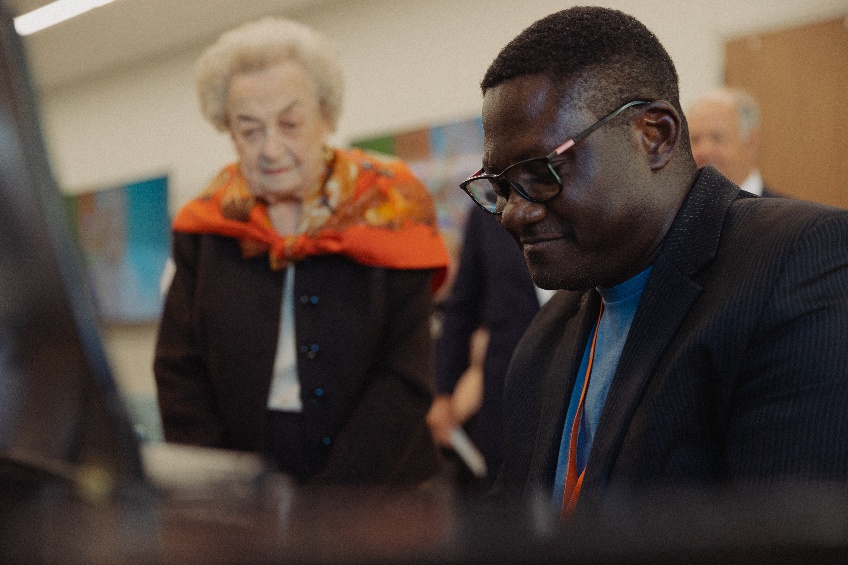 also extends beyond the lab. A jazz pianist for more than 20 years, he has shared music with the UT Health San Antonio community, including a performance at the opening ceremony for the Center for Brain Health. In that setting, music became another way to connect with patients, colleagues and community members — reflecting his belief that health is shaped not only by science, but also by human connection.
In his research, Kolo is advancing the same commitment to healthier communities.
He remains particularly proud of his work examining the relationship between hearing and cognition, dementia and cardiovascular health.
“Knowing my work could contribute to better care and healthier communities reinforced that I had chosen the right path,” he said.
Being selected as a Presidential Ambassador Scholar reinforced that sense of purpose, as the scholarship represents values beyond financial assistance.
“The scholarship represents recognition, encouragement and belief in my potential,” he said.
Supported by the Health Excellence Circle, the scholarship is also opening doors outside of the classroom. Through networking and speaking opportunities, he represents the Kate Marmion School of Public Health with gratitude while connecting with community leaders across Texas and continuing to grow as a public health leader.
"The donors' generosity has invested not only in my education, but also in my future ability to serve others. I am committed to making the most of my opportunities by striving for excellence and giving back to my community and profession."
Francis Kolo, Kate Marmion School of Public Health
Whether through research, public health practice or music, Kolo is guided by the same purpose: to contribute to healthier communities and to help more people access the care and support they need.