At the Mays Cancer Center, home to the UT Health San Antonio MD Anderson Cancer Center, holistic cancer care is not just a clinical model; it is a community commitment. Rehabilitation medicine accompanies patients at every stage, from the moment of diagnosis through survivorship, ensuring that healing addresses both body and mind.
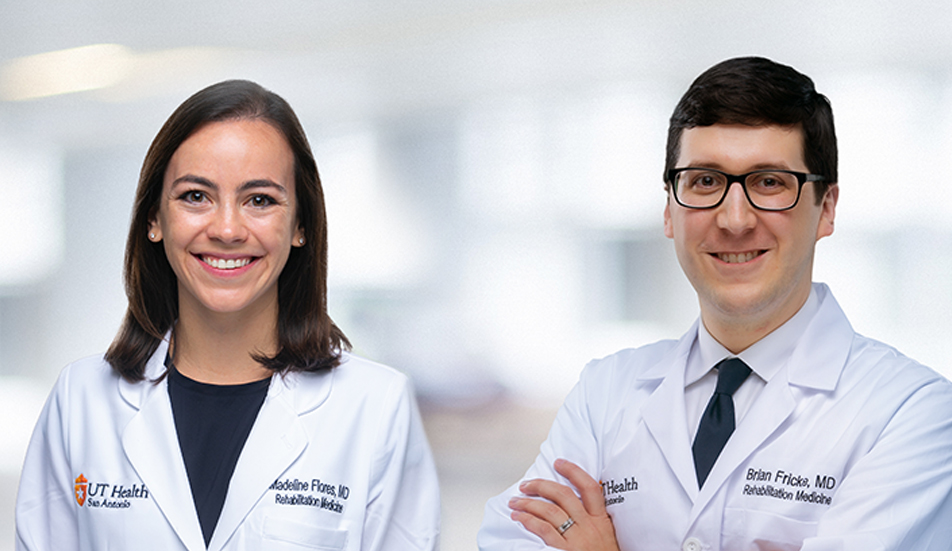
Leading this transformative approach are Madeline Flores, MD, and Brian Fricke, MD, both proud San Antonio natives and practicing doctors at Mays Cancer Center. After pursuing advanced training in cancer rehabilitation medicine at top institutions, they returned home to help reimagine what recovery can look like for their hometown.
Today, Flores and Fricke co-direct an innovative program dedicated to supporting patients during cancer treatment and as they reclaim their lives afterward — empowering individuals to live fully beyond cancer.
"We’re here to support you through your cancer journey and help manage side effects and improve quality of life."
Madeline Flores, MD, Physical Medicine, Cancer Rehabilitation
In rehabilitation medicine, success is defined by clinical milestones and by what patients are able to do again in their day-to-day life outside of treatment.
That might mean returning to work, caring for loved ones, or performing everyday tasks like walking across a room. Fricke describes the specialty as translational medicine, in which medical complexity can be translated into practical, human-centered rehabilitation goals.
“We’re probably some of the few doctors who will ask what patients like to do for fun,” he said. “That becomes the foundation for everything we build around their recovery.”
Patients often arrive believing their limitations are permanent. The phrase “This is my life now; this is as good as it gets,” is one the physicians frequently hear. That belief becomes a turning point in care. With every patient, the team works to identify what can still be improved, even in small ways. Those improvements, they say, often become the first step toward a larger path to recovery.
"Even small improvements matter. We never let perfect be the enemy of good."
Brian Ficke, MD, Physical Medicine, Cancer Rehabilitation
The program now spans the full journey of care, from prehabilitation before treatment begins, to survivorship support after it ends. Patients are also seen during hospitalization to prevent functional decline and support safer, faster recovery.
Flores and Fricke are also building expanded survivorship and inpatient programs designed to ensure patients are surviving their battle with cancer — and living life beyond it.
Still, they acknowledge the system is growing faster than its infrastructure.
“We don’t have dedicated research coordinators or a full research infrastructure yet,” Fricke said. “A lot of work falls to us while we are also managing full clinical schedules.”
For both physicians, philanthropic support is what makes the necessary expansion possible.
As one of the only programs of its kind serving South Texas, continued growth depends on the generosity of philanthropic partners who share a commitment to improving the lives of cancer patients.
“Donor support helps us buy bandwidth,” Flores said. “It allows us to expand services, support research and reach more patients across South Texas.”
Even small contributions can make a difference. From research and development to practical tools that support continued patient recovery at home, donor support for cancer initiatives fuels discoveries for tomorrow, directly impacting the lives of countless cancer patients and their families.
The core of Flores’ and Fricke’s work is restoring hope in moments when patients often expect none.
"We’re never-ending optimists of rehab."
Brian Ficke, MD, Physical Medicine, Cancer Rehabilitation
And for patients who arrive believing nothing more can be done, that optimism may be its own form of care.
Interested in learning how you can support the cancer rehabilitation program at UT Health San Antonio? Contact UT Health San Antonio Advancement and Alumni Engagement at Give@uthscsa.edu. Your gift to our cancer initiatives drives leading-edge patient care.